Rainbow Mountain in Peru Looks Like a Landscape From Another World
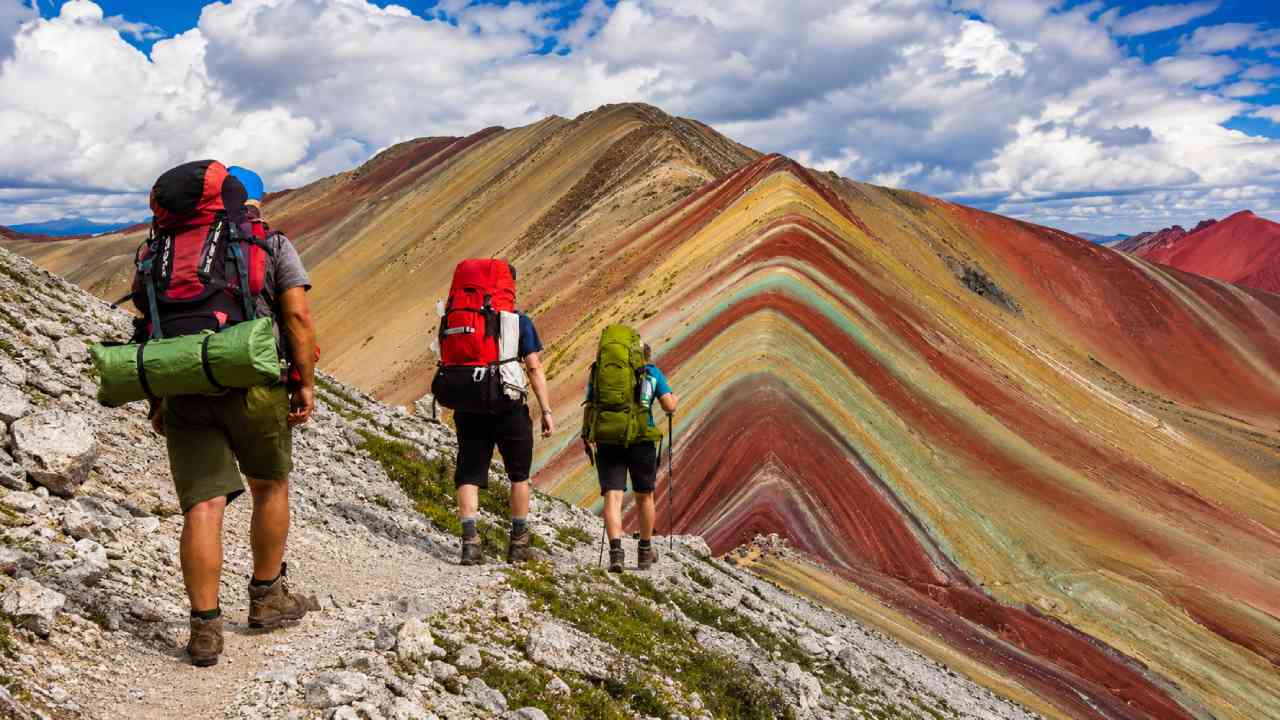
Trans to Find – Rainbow Mountain rises high in the Peruvian Andes with bands of red, yellow, green, brown, and purple stretching across its slopes. Officially known as Vinicunca, this unusual mountain sits in the Cusco region and has become one of Peru’s most recognizable natural attractions. At first glance, the landscape can look digitally enhanced. However, the colorful layers are connected to the area’s geological composition rather than artificial decoration. Different minerals and sediments contribute to the shades visible across the mountain. Meanwhile, its exposed slopes make those geological patterns easier to see. The surrounding landscape adds even more drama. Wide valleys, distant peaks, and an enormous sky create a setting that feels far removed from an ordinary mountain trail. For many visitors, the first sight of Vinicunca creates a simple question: how can a real mountain naturally contain so many colors?
Vinicunca Sits High in the Peruvian Andes
Part of Rainbow Mountain’s extraordinary appearance comes from its location. Vinicunca stands at roughly 5,000 meters above sea level in the Andes, southeast of Cusco. At that elevation, the environment feels open and exposed. Large forests do not hide the mountain’s surface. Instead, visitors see broad slopes, high-altitude grasslands, valleys, and distant peaks. This geography gives the colorful bands plenty of visual space. However, the altitude also makes visiting more challenging than the photographs might suggest. Oxygen levels are lower than at sea level, so walking can feel demanding even for physically active travelers. Consequently, many visitors spend time in Cusco or another high-altitude location before attempting the journey. Acclimatization can help the body adjust gradually. In my view, this physical setting is essential to understanding Vinicunca. It is not simply a colorful landmark. It is part of a vast high-Andean environment where weather and elevation shape the entire experience.
Minerals Created the Mountain’s Remarkable Colors
The famous colors of Rainbow Mountain developed through geological processes that took place over immense periods of time. Sedimentary layers accumulated with different mineral compositions. Later, tectonic activity associated with the formation of the Andes lifted and exposed those layers. Erosion then helped reveal the patterns visible today. Iron-rich materials contribute strongly to red and reddish-brown tones. Other mineral combinations can produce yellow, greenish, pale, and darker bands. Therefore, the mountain resembles a geological cross-section displayed across an enormous natural surface. The colors do not appear as perfectly separated stripes. Instead, they blend and shift as the layers follow the shape of the terrain. This irregularity is part of what makes Vinicunca fascinating. It reminds visitors that the landscape was not designed for visual symmetry. Rather, its appearance is the result of geology, erosion, climate, and time working together.
Read Also: Apple Eyes China’s CXMT for Memory Chips, but U.S. Rules Complicate the Plan
The Real Colors Can Look Different From Online Photos
Travel photographs have played a major role in making Rainbow Mountain famous. Yet they can also create unrealistic expectations. Many online images increase saturation, contrast, clarity, or warmth, making the mountain appear brighter than it may look in person. The natural colors are real, but their intensity changes with environmental conditions. For example, direct sunlight can make individual layers easier to distinguish. Cloud cover may create softer shades. Meanwhile, rain, mist, or snow can dramatically alter the appearance of the slopes. Even the time of day affects how the colors are perceived. Therefore, visitors should not expect the mountain to look identical to a heavily edited travel photograph. In fact, the more subtle natural version can be more interesting. Standing in front of the mountain reveals texture, scale, weather, and depth that a saturated image cannot fully communicate. The experience is less about finding a perfect photograph and more about seeing an unusual geological landscape firsthand.
Reaching Rainbow Mountain Is Part of the Adventure
A trip to Vinicunca usually begins long before visitors see its famous stripes. Many travelers start from Cusco and travel by road toward the trail area. From there, the journey continues through high-altitude terrain. Along the way, the scenery gradually changes. Agricultural areas give way to broad mountain landscapes, while the air becomes noticeably colder and thinner. Llamas and alpacas may appear across the surrounding grasslands, adding another distinctly Andean element to the journey. Eventually, hikers reach higher viewpoints where the colorful formations become increasingly visible. The final approach can be physically demanding because of the altitude. Therefore, moving slowly is often more sensible than trying to maintain a fast hiking pace. Weather can also change quickly in the mountains. A clear morning may become cloudy or cold within a relatively short period. Those challenges make the destination feel less like a simple sightseeing stop and more like a genuine high-altitude excursion.
Weather Can Completely Change the Experience
Few factors influence a visit to Rainbow Mountain as much as the weather. Clear conditions can reveal the contrasting colors across the slopes, while clouds may reduce visibility within minutes. Rain can make trails more difficult, and snowfall can partially cover the mineral layers that visitors came to see. Moreover, temperatures at high elevation can feel cold even when conditions in Cusco are relatively comfortable. This unpredictability is one reason travelers should approach the mountain as a natural environment rather than a guaranteed photo opportunity. Proper layers, suitable footwear, sun protection, and water can make the experience more manageable. It is also sensible to check current local conditions before traveling. However, imperfect weather does not necessarily ruin the landscape. Clouds moving across the Andes can create dramatic scenes that look completely different from the classic bright photographs. In some ways, the changing atmosphere reinforces the feeling that Vinicunca belongs to a much larger and more powerful mountain environment.
Rainbow Mountain Became Famous Surprisingly Recently
Compared with Peru’s internationally famous archaeological attractions, Vinicunca’s rise as a major tourism destination is relatively recent. The mountain existed long before social media, of course, and local communities were familiar with the landscape. However, its global tourism profile expanded rapidly as photographs circulated online. Images of its colorful slopes were ideal for visually driven travel platforms. As more visitors shared photographs, curiosity grew. Soon, Rainbow Mountain became a recognizable addition to many Cusco itineraries. This rapid popularity demonstrates how digital media can transform an unusual landscape into an international attraction. Nevertheless, increased tourism also creates responsibilities. Trails, local communities, waste management, and fragile high-altitude environments can all face greater pressure when visitor numbers rise quickly. Therefore, responsible travel matters. Following designated routes, respecting local guidance, and avoiding unnecessary disturbance can help protect the landscape that attracted visitors in the first place.
The Surrounding Andes Are Just as Important as the Colors
It is easy to focus entirely on the colorful mountain, yet the surrounding scenery deserves equal attention. Vinicunca belongs to a much broader Andean landscape shaped by high peaks, valleys, exposed ridges, and open grasslands. Nearby views can include the snow-covered Ausangate massif, one of the most prominent mountains in the region. Consequently, the experience is not limited to one striped slope. Turning away from the main viewpoint can reveal landscapes that are equally dramatic, even without the famous colors. This wider perspective also helps explain why photographs sometimes fail to capture the true scale of the destination. A close image emphasizes individual bands, while standing there reveals how small people appear against the surrounding mountains. For travelers who enjoy natural landscapes, that sense of scale may become one of the most memorable parts of the visit. Rainbow Mountain provides the initial attraction, but the Andes provide the complete setting.
Palccoyo Offers Another Colorful Andean Experience
Vinicunca is not the only place near Cusco where visitors can encounter colorful mountain formations. Palccoyo has become another option for travelers interested in Peru’s unusual geological landscapes. Rather than focusing on one famous viewpoint, the Palccoyo area offers several colorful formations within a broad mountain setting. The experience also differs from Vinicunca in terms of trail layout and visitor patterns. Therefore, travelers should not necessarily view the two destinations as identical alternatives. Each offers a different perspective on the mineral-rich geology of the Andes. Those who have enough time may even find value in exploring both. Doing so shows that Peru’s colorful terrain is not limited to a single social-media landmark. Instead, it belongs to a wider geological region shaped by similar natural forces. That context makes Rainbow Mountain more interesting because it becomes part of a larger story rather than an isolated visual curiosity.
Why Rainbow Mountain Feels Almost Unreal
Several visual elements combine to make Rainbow Mountain feel otherworldly. First, the exposed mineral bands create colors that people rarely associate with mountains. Second, the high altitude limits dense vegetation, leaving the geological structure visible across broad areas. Finally, the enormous Andean sky and distant peaks provide a dramatic background. Together, these features challenge the familiar image of what a mountain should look like. Most people expect gray rock, green vegetation, or white snow. Vinicunca adds reds, yellows, greens, and purples to that palette. Yet its unusual appearance is precisely what makes the landscape valuable from both travel and geological perspectives. It shows how natural processes can create scenery that seems almost artificial. At the same time, visitors should remember that the mountain is not a static image. Light, clouds, seasons, and weather continuously change its appearance. The real Vinicunca is more complex than the perfectly saturated version often seen online.
Rainbow Mountain Is More Than an Instagram Photograph
The strongest reason to appreciate Rainbow Mountain goes beyond its photogenic appearance. Vinicunca provides a visible lesson in geology while also introducing visitors to the scale and environmental conditions of the Peruvian Andes. Its colors tell a story about minerals, sediment, tectonic forces, erosion, and immense stretches of time. Meanwhile, the journey reveals another side of the destination through altitude, changing weather, local communities, and high-mountain scenery. That combination gives the experience more depth than a single photograph can provide. Travelers who arrive only expecting an intensely colorful backdrop may overlook much of what makes the area remarkable. Instead, slowing down and observing the surrounding landscape can reveal why the mountain deserves attention. Rainbow Mountain may look like somewhere from another world, but its most fascinating quality is exactly the opposite. Everything about it was created by processes occurring on Earth, making its seemingly impossible appearance even more extraordinary.