Mount Roraima, a Surreal Adventure Above the Clouds
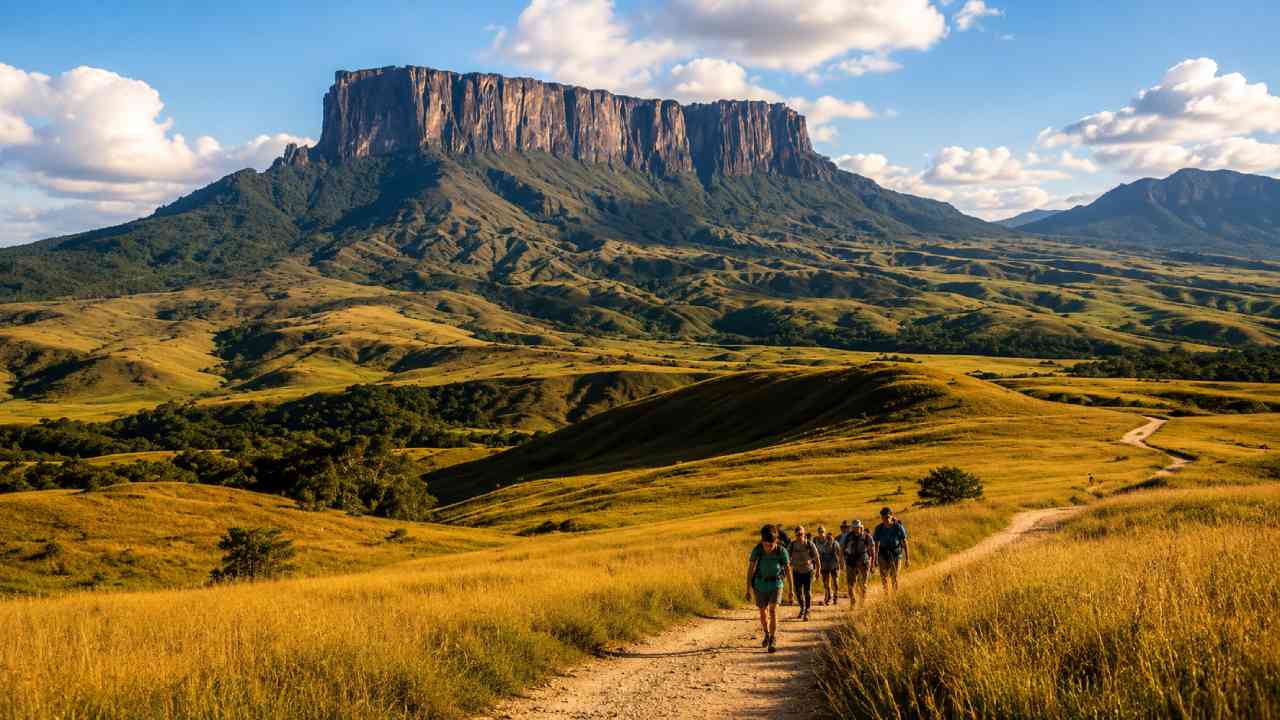
Trans to Find – Mount Roraima rises dramatically above the landscapes of northern South America, creating a scene that almost seems digitally imagined. Its enormous cliffs, flat summit, drifting clouds, and isolated ecosystem make it unlike a typical mountain destination. Located in the Guiana Highlands, the famous tepui is associated with the border region shared by Venezuela, Guyana, and Brazil. Most trekking routes approach it through Venezuela. Rather than ending in a narrow peak, Roraima opens into a vast plateau filled with dark rocks, pools, mist, and unusual vegetation. Consequently, reaching the top feels less like completing a conventional climb and more like entering another landscape entirely. For travelers drawn to remote places, that contrast is part of its appeal. The journey offers adventure, remarkable geology, and an opportunity to experience one of South America’s most distinctive natural environments.
A Tabletop Mountain Rising Above the Landscape
The unusual shape of Mount Roraima comes from its identity as a tepui, or tabletop mountain. Unlike younger mountain ranges with sharp peaks, tepuis feature broad summits surrounded by dramatic cliffs. Roraima reaches roughly 2,800 meters above sea level at its highest point. From a distance, its enormous walls appear to rise almost vertically from the surrounding landscape. Clouds frequently gather around the cliffs, sometimes hiding the summit completely. Then, as conditions change, sections of the massive rock face suddenly emerge from the mist. This constantly changing view gives the mountain much of its surreal character. Furthermore, the summit’s isolation has influenced the environment found above. Travelers who have spent days approaching the mountain from below encounter a striking transition when they finally reach its upper plateau. The familiar green scenery gives way to a darker and stranger world shaped by rock, water, wind, and time.
The Trek Begins Across a Vast Savanna
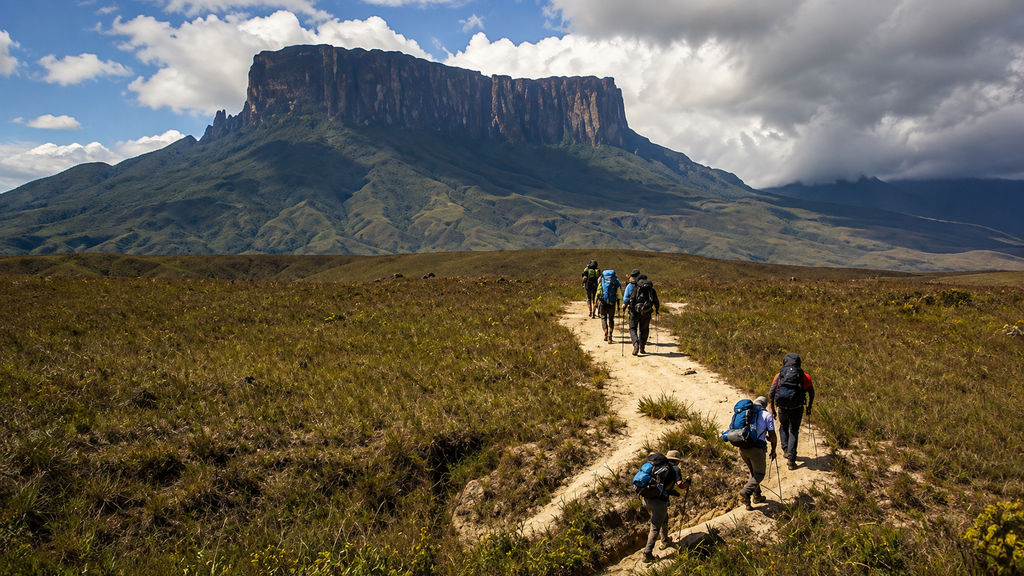
For many visitors, the adventure starts long before reaching Mount Roraima itself. Trekking routes from Venezuela generally cross open savanna before arriving at the base of the tepui. During this section, the mountain can dominate the horizon while still appearing frustratingly distant. That gradual approach is an important part of the experience. Instead of arriving at a viewpoint by vehicle and immediately seeing the main attraction, hikers watch the landscape change over several days. Rivers, grasslands, changing weather, and increasingly imposing cliffs build anticipation. Eventually, the trail approaches the towering rock walls. From there, the journey becomes steeper as hikers make their way toward the plateau. Because the trek involves remote terrain and unpredictable conditions, preparation matters. Travelers should consider fitness, suitable clothing, reliable equipment, local guidance, and current travel conditions before attempting the route.
Read Also: Ivan Ortola Leads Moto2 Aragon Practice as Mario Aji Faces Q1 Battle
Reaching the Summit Reveals an Unexpected World
Standing on top of Mount Roraima can challenge expectations of what a mountain summit should look like. Instead of a small peak surrounded by open views, travelers enter a broad plateau with its own complex terrain. Dark sandstone formations rise from the surface in unusual shapes. Shallow pools collect between rocks, while narrow channels carry rainwater across the landscape. Mist can arrive quickly and reduce visibility, adding another layer of mystery. Meanwhile, erosion has sculpted the rock over immense periods into formations that invite imaginative comparisons. Some appear like towers, animals, or strange sculptures depending on the viewing angle. The environment feels remarkably different from the savanna below. For photographers, this provides endless compositions. However, the fragile landscape deserves respect. Visitors should follow established guidance, avoid damaging vegetation, and minimize their impact while exploring this unusual high-altitude environment.
Water and Clouds Constantly Transform the Scenery
Weather is not merely background scenery on Mount Roraima. It actively shapes the travel experience. Moist air frequently surrounds the tepui, producing fog, rain, and fast-moving clouds. Water collects across the plateau before flowing toward the enormous cliffs. In some locations, streams eventually plunge from the edges as waterfalls. Strong winds and the height of the drops can turn falling water into mist, creating dramatic scenes around the mountain walls. However, these same conditions can make trekking more challenging. Wet rocks become slippery, trails can become muddy, and visibility may change rapidly. Therefore, travelers should not expect perfectly clear skies throughout the journey. In fact, the shifting weather is part of what gives Roraima its atmosphere. A cliff hidden by cloud in the morning may appear suddenly in the afternoon. Every change can make the same landscape look completely different.
Isolation Has Created a Fascinating Natural Environment
The summit of Mount Roraima is more than a spectacular viewpoint. Its long geographic isolation has helped create unusual ecological conditions. Tepui environments are known for species that have adapted to nutrient-poor soils, heavy rainfall, and distinctive high-altitude habitats. Some plants found across these uplands have limited distributions, making conservation especially important. Carnivorous plants are among the fascinating examples associated with tepui ecosystems. They obtain additional nutrients by capturing small insects, an adaptation that can be useful where soil nutrients are limited. However, visitors should resist touching or collecting plants. These environments developed over extraordinary periods, while careless human activity can cause damage quickly. From a travel perspective, this ecological story adds another dimension to the journey. Mount Roraima is impressive not simply because of its cliffs, but because the summit functions as an unusual natural world shaped by isolation.
Ancient Geology Explains the Mountain’s Unreal Appearance
The surreal appearance of Mount Roraima has a geological foundation. The tepuis of the Guiana Highlands contain extremely old rock formations that have undergone immense periods of weathering and erosion. Over time, surrounding material was worn away, leaving isolated table mountains towering above lower landscapes. Rain, wind, and flowing water continued sculpting their exposed surfaces. That slow process helps explain the strange rock formations found across Roraima’s plateau today. It also explains why the mountain feels visually different from many familiar alpine destinations. There are no classic snow-covered triangular peaks. Instead, travelers encounter enormous vertical walls topped by a broad rocky world. Understanding this geological history can make the trip more meaningful. The cliffs are not merely dramatic backgrounds for photographs. They represent natural processes operating over timescales far beyond human experience, which gives the landscape an extraordinary sense of age.
The Lost World Connection Adds to Roraima’s Mystique
Mount Roraima is frequently associated with Arthur Conan Doyle’s 1912 adventure novel The Lost World. The novel follows an expedition to an isolated South American plateau where prehistoric creatures have survived. Over time, Roraima has become strongly connected with that imagery in popular travel storytelling. However, claims that this particular mountain alone directly inspired every aspect of the fictional setting should be treated carefully. Reports and descriptions of South America’s remote table mountains contributed to a wider fascination with unexplored plateau landscapes. Even without exaggerating that connection, it is easy to understand why Roraima feels appropriate for a lost-world narrative. Its vertical cliffs appear to separate the summit from everything below. Meanwhile, fog, strange rocks, isolated habitats, and unusual plants reinforce the impression of entering somewhere hidden. The literary association adds intrigue, but the real landscape is remarkable enough without fictional embellishment.
Hiking Mount Roraima Requires Serious Preparation
The beauty of Mount Roraima should not disguise the demands of reaching it. This is a multi-day wilderness trek rather than a casual sightseeing stop. Travelers may encounter long walking days, river crossings, steep sections, rain, mud, and limited facilities. Conditions on the plateau can also be wet and cool, especially when clouds settle over the mountain. Therefore, appropriate footwear, weather protection, and suitable camping equipment are important. Local guides and organized trekking arrangements can also provide valuable knowledge about routes and conditions. In addition, international travelers should review current entry requirements, regional security information, transportation options, and official travel advice before making plans. Conditions can change, so older travel stories should not replace current information. Preparing carefully does not reduce the sense of adventure. Instead, good planning gives travelers a better chance to appreciate the environment without turning avoidable problems into emergencies.
Responsible Travel Matters in a Fragile Landscape
Remote destinations can feel untouched, but increased tourism can still leave a noticeable footprint. Mount Roraima’s summit contains delicate habitats that deserve careful treatment. Travelers should avoid leaving waste, disturbing plants, removing rocks, or creating unnecessary new paths. Campsites and sanitation also require responsible management because decomposition can occur differently in high-altitude environments. Moreover, working with responsible local operators can support communities connected to the trekking routes. Indigenous knowledge and local experience are particularly valuable in landscapes where weather and trail conditions can change quickly. Responsible travel is not about making an adventure less enjoyable. Rather, it protects the qualities that made the destination worth visiting in the first place. Roraima’s appeal comes from its remoteness and unusual natural character. Preserving that atmosphere requires visitors to treat the mountain as a living environment rather than simply a backdrop for photographs.
Mount Roraima Rewards Travelers Who Embrace the Journey
Mount Roraima offers something increasingly rare in modern travel: a destination where reaching the attraction is inseparable from experiencing it. The long approach across the savanna, the first close view of the cliffs, the climb toward the plateau, and the changing weather all become part of the story. Once above the clouds, the summit reveals an environment filled with unusual rocks, water, mist, and specialized vegetation. There may be easier destinations for travelers seeking comfort or predictable conditions. However, Roraima appeals to those who value remote landscapes and the feeling of gradually discovering somewhere extraordinary. Its beauty is not polished or convenient. Instead, it is wild, atmospheric, and sometimes challenging. That combination makes the mountain more than another scenic viewpoint. For prepared travelers, it can become one of those rare journeys where the landscape feels almost imaginary, even while standing directly inside it.