Discover Grand Prismatic Spring, Yellowstone’s Surreal Rainbow Pool
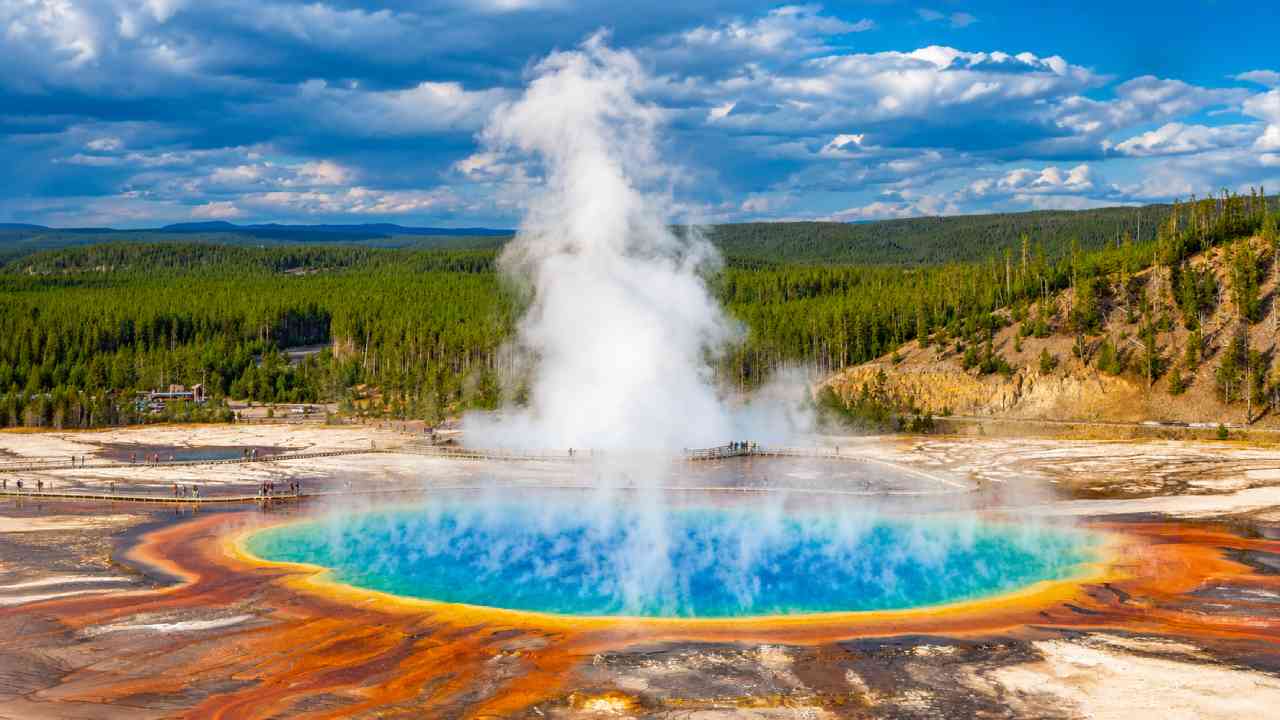
Trans to Find – Imagine walking through a volcanic landscape and suddenly seeing brilliant blue water surrounded by rings of yellow, orange, and rust-red color. The scene looks digitally enhanced, yet nature created every shade. Travelers who Discover Grand Prismatic Spring encounter one of the most recognizable geothermal landscapes in Yellowstone National Park. Located in the Midway Geyser Basin, this enormous hot spring combines intense heat, microscopic life, and unusual geology. Steam frequently drifts across the water, adding another layer of drama to the experience. However, its beauty comes with an important reminder: Yellowstone’s thermal areas are powerful and potentially dangerous. Visitors must remain on designated routes and follow park guidance. From the boardwalk to the elevated overlook, Grand Prismatic Spring offers a rare opportunity to see science and extraordinary natural beauty occupying the same landscape.
A Rainbow Hidden Inside Yellowstone
Yellowstone contains thousands of hydrothermal features, yet Grand Prismatic Spring immediately stands apart. Its enormous circular shape and vivid colors make it look more like abstract art than a natural pool. The center appears intensely blue, while warmer shades spread around the edges. Meanwhile, pale mineral ground surrounds the spring and increases the visual contrast. Steam moves constantly across the surface, so the view can change within minutes. One moment, visitors may see only fragments of blue through the mist. Shortly afterward, a breeze can reveal the entire colorful surface. This unpredictability makes the experience especially memorable. Photographs often emphasize the spring’s surreal appearance, but standing near it adds sound, heat, movement, and scale. Consequently, the landscape feels more dynamic in person than a single image can capture.
Why Grand Prismatic Has So Many Colors
The spring’s remarkable colors come from a combination of water, temperature, light, and heat-loving microorganisms. Different microbial communities thrive within particular temperature ranges around the cooler margins. Their pigments help create bands of yellow, orange, and brown. Meanwhile, the extremely hot central area supports different conditions and appears intensely blue. The blue color relates to the way light interacts with the clear, deep water. Therefore, the famous rainbow appearance is not simply a mineral stain or photographic effect. It reflects an active geothermal ecosystem. The colors can also vary with environmental conditions and seasons as microbial communities respond to temperature changes. This scientific explanation makes the view even more impressive. When travelers Discover Grand Prismatic, they are not simply looking at unusual colors. They are observing visible signs of biology and geothermal energy working together.
Read Also: Aldio Oekon Stages Remarkable APRC Comeback After Rally Car Rollover
One of Yellowstone’s Largest Hot Springs
Grand Prismatic Spring impresses visitors with more than color. Its scale can be difficult to understand until you see it from above. According to the National Park Service, the spring measures approximately 370 feet, or 113 meters, across. It also reaches more than 121 feet, around 37 meters, deep. Those dimensions make it Yellowstone’s largest hot spring. From the boardwalk, however, visitors stand so close to the feature that its complete shape can be difficult to appreciate. Steam may further limit the view. For that reason, the elevated overlook offers a valuable second perspective. From higher ground, the blue center and surrounding bands become much easier to distinguish. Seeing the spring from both viewpoints provides a stronger sense of its size. The experience changes from an intimate geothermal encounter below to a sweeping landscape view above.
The Boardwalk Offers a Close-Up Experience
The Midway Geyser Basin boardwalk brings visitors remarkably close to Yellowstone’s geothermal environment. As you move along the designated route, steam drifts across the path and warm air rises from nearby features. Grand Prismatic Spring gradually comes into view rather than appearing all at once. Up close, visitors can notice subtle changes in color and texture around its margins. However, the spring’s immense size means the boardwalk does not provide the famous aerial-style perspective often seen in photographs. That limitation is not necessarily disappointing. Instead, the close viewpoint reveals how active the landscape feels. Water moves, steam shifts, and colorful microbial mats spread across the surrounding ground. Most importantly, visitors should stay on the boardwalk. Thermal ground can hide dangerously hot water beneath a thin surface. Following established routes protects both travelers and the fragile geothermal environment.
The Overlook Reveals the Famous Rainbow View
Travelers hoping to see Grand Prismatic Spring as a complete rainbow-colored pool should consider the Grand Prismatic Overlook. The elevated viewpoint provides enough distance to appreciate the feature’s overall shape. From there, the deep blue center appears surrounded by broad bands of warmer color. The surrounding forest creates an additional contrast, making the spring seem almost unreal. Reaching the viewpoint requires a walk, so comfortable footwear and basic preparation help. Weather also matters. Cooler air can produce heavier steam, while clearer and warmer conditions may reveal more of the water’s surface. Therefore, no two visits look exactly the same. For photographers, patience can make a major difference. Waiting for steam to shift may transform a partially hidden view into a spectacular scene. This viewpoint explains why Grand Prismatic has become such a recognizable symbol of Yellowstone.
Why Steam Can Completely Change the View
Visitors sometimes arrive expecting an unobstructed rainbow and instead find clouds of steam covering much of the spring. This is a normal part of the geothermal experience. Hot water continuously transfers heat into the surrounding air. When cooler air passes over the surface, visible steam can become especially noticeable. Consequently, mornings and colder conditions may produce a very different scene from warmer parts of the day. Wind also changes the view quickly by moving steam across the basin. Rather than treating this as a flaw, travelers can see it as part of the landscape’s character. The spring is not a static attraction designed for perfect photographs. It is an active natural system. When you Discover Grand Prismatic, the changing steam makes each visit slightly unpredictable. That uncertainty can make the moment when the colorful pool finally appears even more rewarding.
The Best Experience Comes From Respecting the Landscape
Grand Prismatic Spring may look inviting, but its beauty should never encourage visitors to leave designated routes. Yellowstone’s hydrothermal areas contain extremely hot water and fragile ground. A surface that appears solid can hide dangerous conditions underneath. Therefore, boardwalks and marked trails serve an essential safety purpose. They also protect microbial communities that contribute to the spring’s extraordinary colors. Visitors should avoid touching thermal water, throwing objects into geothermal features, or stepping onto sensitive ground. These rules may sound restrictive, yet they help preserve an environment that took natural processes to create. Responsible travel becomes especially important at popular destinations where large numbers of visitors can place pressure on delicate landscapes. In my view, Grand Prismatic is most impressive when travelers understand that they are guests inside an active geothermal system rather than visitors to an artificial attraction.
Photography Requires Patience Rather Than Heavy Editing
Grand Prismatic Spring already provides enough natural color to create striking photographs. However, conditions can change rapidly. Steam, clouds, sunlight, and viewing angle all influence how intense the colors appear. The elevated overlook usually provides a broader composition, while the boardwalk works better for details and atmospheric scenes. A clear day can emphasize the blue center, whereas drifting steam creates a more mysterious image. Nevertheless, photographs should represent the landscape realistically. Excessive saturation can make an already extraordinary destination appear artificial. This matters because Grand Prismatic does not need dramatic editing to look surreal. Its natural contrast provides the visual impact. Travelers should also remember that photography comes after safety. Remaining on marked paths is far more important than finding an unusual angle. Sometimes, the strongest travel image comes from patiently observing the scene rather than chasing a perfect social media shot.
Grand Prismatic Is More Than an Instagram View
It would be easy to treat Grand Prismatic Spring simply as a spectacular photo destination. Yet doing so misses much of what makes the place extraordinary. Beneath its colorful surface lies a story about volcanic heat, water circulation, microorganisms, and Yellowstone’s complex geology. The spring demonstrates how extreme environments can support specialized forms of life. At the same time, its scale reminds visitors that Yellowstone remains geologically active. This combination gives the destination more depth than its famous appearance suggests. Reading about the geothermal system before visiting can make the experience more meaningful. Suddenly, orange edges become evidence of microbial communities rather than simple decoration. Steam becomes part of an active thermal process. Therefore, travelers who Discover Grand Prismatic with some scientific context can appreciate both the visual spectacle and the natural mechanisms creating it.
A Landscape That Truly Looks Like Another World
Few travel destinations blur the line between reality and fantasy as effectively as Grand Prismatic Spring. Its electric-blue center, fiery margins, drifting steam, and pale geothermal terrain create a combination rarely seen elsewhere. Yet perhaps the most remarkable detail is that none of it requires artificial design. Natural processes produce the colors, patterns, and atmosphere that make the spring famous. Visitors can experience it from close range along the boardwalk, then step back at the overlook to understand its enormous scale. Together, those perspectives reveal why the destination leaves such a lasting impression. To Discover Grand Prismatic is to see a place where geology and microscopic life create something that resembles a painting. Yellowstone contains many remarkable landscapes, but this rainbow pool remains one of its most surreal expressions of nature.